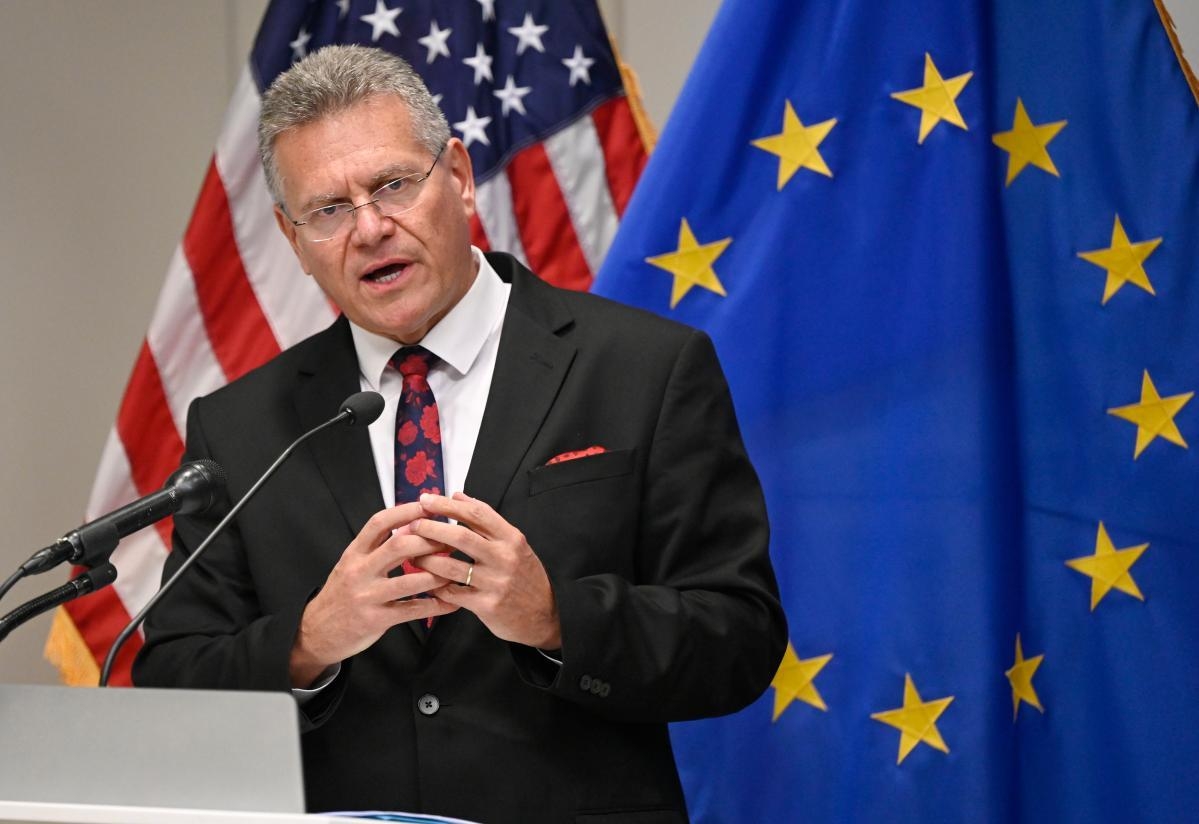
European and American trade officials are locked in a tense diplomatic sprint to rescue the EU–US trade agreement reached last summer at Turnberry from potential collapse. On Monday (9 March), US Treasury Secretary Scott Bessent reached out to EU Trade Commissioner Maroš Šefčovič to reaffirm Washington’s commitment to the pact. Yet even as reassurances were being offered in private, the Trump administration launched this week sweeping new trade investigations against the EU, shattering any illusion of calm and leaving Brussels scrambling to prevent a return to the full-scale tariff war that has threatened transatlantic commerce since President Donald Trump returned to the White House.
The Turnberry standstill
The Turnberry Agreement, struck at President Trump’s Scottish golf resort last August, set a ceiling of 15 per cent on American tariffs applied to most EU exports, while the EU pledged to eliminate all its tariffs on US industrial and agricultural goods. On paper, it was a significant achievement. In practice, it has languished in the European Parliament until now.
The holdup began in February, when the US Supreme Court struck down the broad “reciprocal” tariffs that President Trump had imposed under emergency powers, throwing the deal’s legal underpinning into question. MEPs paused their deliberations and demanded fresh guarantees from Washington. The Trump administration subsequently imposed a temporary flat 10 per cent blanket tariff under a different legal authority, adding to the uncertainty rather than resolving it.
Trade Commissioner Šefčovič mounted a last-ditch effort in Strasbourg on Tuesday (10 March), briefing senior MEPs on his conversations with the Trump administration in a bid to break the impasse. His intervention appears to have had some effect. Bernd Lange, the Chair of the EP’s International Trade committee (INTA), said that lead MEPs would convene on 17 March to decide whether to proceed to a committee vote on 19 March, which would then pave the way for a full plenary vote during the mini-plenary in Brussels on 25–26 March.
Washington’s Mixed Signals: Reassurance and Renewed Threats
Even as Mr. Bessent was offering private reassurances, other parts of the Trump administration were projecting a far more combative stance. On Wednesday (11 March), US Trade Representative (USTR) Jamieson Greer March announced the start of a sweeping set of new trade investigations under Section 301 against the EU.
The first probe will examine whether trading partners are fuelling excessive manufacturing capacity. A second investigation, announced on Thursday (12 March), targets 60 partners, including the EU, over alleged failures to prohibit goods made using forced labour. Both investigations carry the realistic prospect of new tariffs that could breach the 15 per cent ceiling promised under the Turnberry Agreement.
However, Mr. Greer also added to the pressure, publicly accusing the EU of implementing “zero per cent” of what was agreed at Turnberry, while insisting that Washington had already moved towards compliance. There is a growing suspicion in Brussels that the Section 301 investigations are a tactical manoeuvre: a way for the White House to rebuild its tariff arsenal on a more legally durable footing following the Supreme Court’s ruling, regardless of the commitments made in Scotland last summer.
In response, the European Commission struck a measured but firm tone. A spokesperson stated that Brussels would respond “firmly and proportionately” to any breach of the Turnberry Agreement, whilst noting that the Commission had received no indication that Washington intended to deviate from its commitments. Officials confirmed they would seek urgent clarification from their US counterparts on how the new probes interact with the existing deal.
A mission to Washington and a looming deadline
With the clock ticking towards the 26 March plenary vote, the European Parliament is sending a high-level delegation to Washington in a final bid to break the deadlock. The group comprises INTA Chair Bernd Lange and the Chair of the EU-US delegation of the European Parliament, Brando Benifei. They hope to meet Mr. Greer on 20 March, although the parliamentary vote may already have been postponed again by then.
Their goal is straightforward but politically fraught: to secure a public statement or concrete guarantee from the US side that the 15 per cent tariff ceiling will be respected regardless of the outcome of the new Section 301 investigations.
The road ahead
The coming weeks could determine the future of EU–US trade relations. If the European Parliament approves the implementing legislation, the Turnberry Agreement could provide a new framework for stability between the two economies. But if the vote is delayed—or if new tariffs emerge from the ongoing investigations, the fragile balance between Brussels and Washington could quickly unravel.